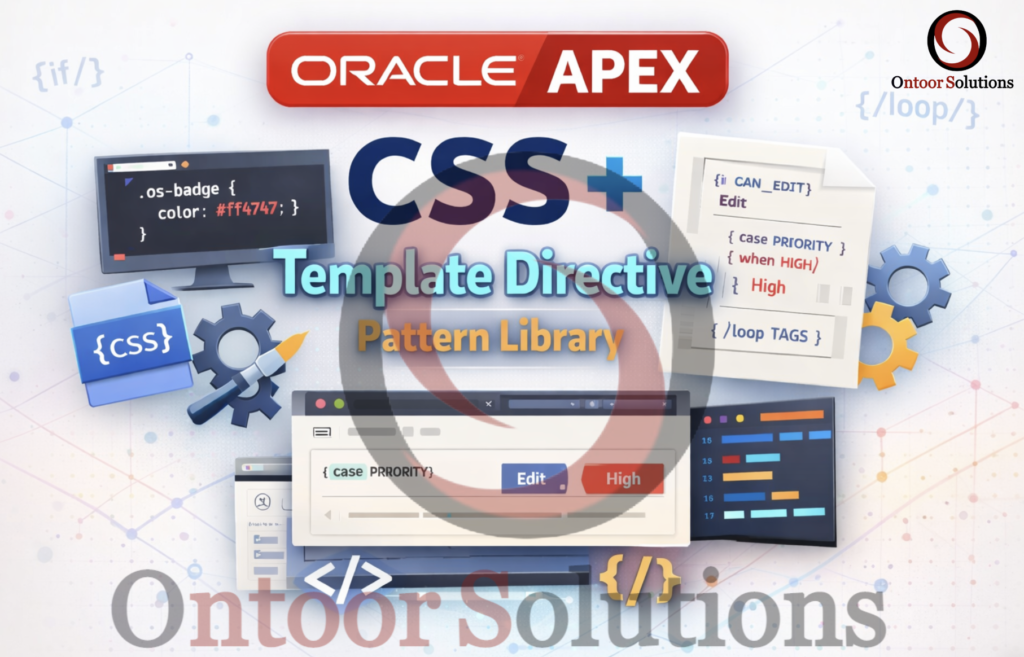

Below is a ready-to-use CSS + Template Directive pattern library you can drop into any Oracle APEX application.
This is meant to be practical, consistent, and team-friendly. No experiments, only patterns that work in real projects.
You can think of this as a mini design system for templates.
Core CSS (Add Once Per App)
Add this in:
Shared Components → Static Application Files or
Theme Roller → Custom CSS
/* ===== Status Badges ===== */
.os-badge {
display: inline-block;
padding: 0.25rem 0.6rem;
border-radius: 12px;
font-size: 0.75rem;
font-weight: 600;
line-height: 1;
white-space: nowrap;
}
.os-badge–success { background: #e6f4ea; color: #137333; }
.os-badge–warning { background: #fef7e0; color: #8a6d1d; }
.os-badge–danger { background: #fdecea; color: #a50e0e; }
.os-badge–info { background: #e8f0fe; color: #1a73e8; }
.os-badge–muted { background: #f1f3f4; color: #5f6368; }
/* ===== Action Links ===== */
.os-link {
color: #1a73e8;
text-decoration: none;
font-weight: 500;
}
.os-link:hover {
text-decoration: underline;
}
/* ===== Empty State ===== */
.os-empty {
color: #757575;
font-style: italic;
}
/* ===== Tags ===== */
.os-tag {
display: inline-block;
margin: 0 4px 4px 0;
padding: 0.2rem 0.5rem;
border-radius: 10px;
font-size: 0.7rem;
background: #f1f3f4;
color: #3c4043;
}
/* ===== Priority Accents ===== */
.os-priority-high { border-left: 4px solid #d93025; padding-left: 6px; }
.os-priority-medium { border-left: 4px solid #f9ab00; padding-left: 6px; }
.os-priority-low { border-left: 4px solid #188038; padding-left: 6px; }
This CSS is neutral, readable, and works well with Universal Theme.
Status Badge Pattern
Template Directive
{case STATUS/}
{when ACTIVE/}
<span class=”os-badge os-badge–success”>Active</span>
{when INACTIVE/}
<span class=”os-badge os-badge–warning”>Inactive</span>
{when CANCELLED/}
<span class=”os-badge os-badge–danger”>Cancelled</span>
{otherwise/}
<span class=”os-badge os-badge–muted”>Unknown</span>
{endcase/}
Where to use
Classic Reports
Cards
Interactive Reports
Emails (inline-safe)
Boolean Flag Pattern (Y/N, 1/0)
{if FLAG/}
<span class=”os-badge os-badge–success”>Yes</span>
{else/}
<span class=”os-badge os-badge–muted”>No</span>
{endif/}
Action Link with Permission
{if CAN_EDIT/}
<a class=”os-link”
href=”f?p=&APP_ID.:10:&SESSION.::NO::P10_ID:&ID.”>
Edit
</a>
{else/}
<span class=”os-empty”>View only</span>
{endif/}
Clean, readable, and safe.
Priority Indicator (Visual + Text)
{case PRIORITY/}
{when HIGH/}
<div class=”os-priority-high”>
<span class=”os-badge os-badge–danger”>High</span>
</div>
{when MEDIUM/}
<div class=”os-priority-medium”>
<span class=”os-badge os-badge–warning”>Medium</span>
</div>
{when LOW/}
<div class=”os-priority-low”>
<span class=”os-badge os-badge–success”>Low</span>
</div>
{endcase/}
Empty State Pattern (Highly Recommended)
{if VALUE/}
&VALUE.
{else/}
<span class=”os-empty”>No data available</span>
{endif/}
Use this everywhere instead of blank cells.
Tags / Labels Pattern
{loop “,” TAGS/}
<span class=”os-tag”>&APEX$ITEM.</span>
{endloop/}
Highlight Special Tags (Loop + Case)
{loop “,” TAGS/}
{case APEX$ITEM/}
{when Critical/}
<span class=”os-badge os-badge–danger”>&APEX$ITEM.</span>
{when Internal/}
<span class=”os-badge os-badge–warning”>&APEX$ITEM.</span>
{otherwise/}
<span class=”os-tag”>&APEX$ITEM.</span>
{endcase/}
{endloop/}
UI State Pattern (Cleanest Architecture)
SQL
CASE
WHEN can_edit = ‘Y’ THEN ‘EDIT’
WHEN can_view = ‘Y’ THEN ‘VIEW’
ELSE ‘NONE’
END AS ui_state
Template
{case UI_STATE/}
{when EDIT/}
<a class=”os-link” href=”…”>Edit</a>
{when VIEW/}
<span class=”os-empty”>View only</span>
{otherwise/}
<span class=”os-badge os-badge–danger”>No access</span>
{endcase/}
This pattern scales best in large apps.
Email Template Pattern (CSS-Safe)
{case STATUS/}
{when APPROVED/}
<span class=”os-badge os-badge–success”>Approved</span>
{when REJECTED/}
<span class=”os-badge os-badge–danger”>Rejected</span>
{otherwise/}
<span class=”os-badge os-badge–muted”>Pending</span>
{endcase/}
Tip: keep CSS simple for email compatibility.
Checkout our sample app
Login: DEMO/DEMO
Team Usage Guidelines
One CSS file, many templates
Never hardcode colours in templates
Prefer {case} over nested {if}
SQL decides state, template decides look
Any snippet reused twice becomes a standard
Final Thought
This library gives you:
Consistent UI
Cleaner templates
Faster development
Easier maintenance
Most APEX template mess happens because CSS and directives grow randomly.
This approach keeps both intentional and reusable.
The post Oracle APEX – CSS + Template Directive Pattern Library appeared first on Ontoor blogs.