
A complete, real-world, file-based integration architecture
Introduction
Oracle Fusion Applications store very important and sensitive business data. However, they are not meant to be accessed directly by custom applications or reporting tools like Oracle APEX. Trying to query Fusion data directly can slow down the system, create security risks, and cause support issues—things that enterprise systems cannot afford.
Because of this, organizations need a safe and reliable way to use Fusion data for reporting and custom applications without touching Fusion at runtime.
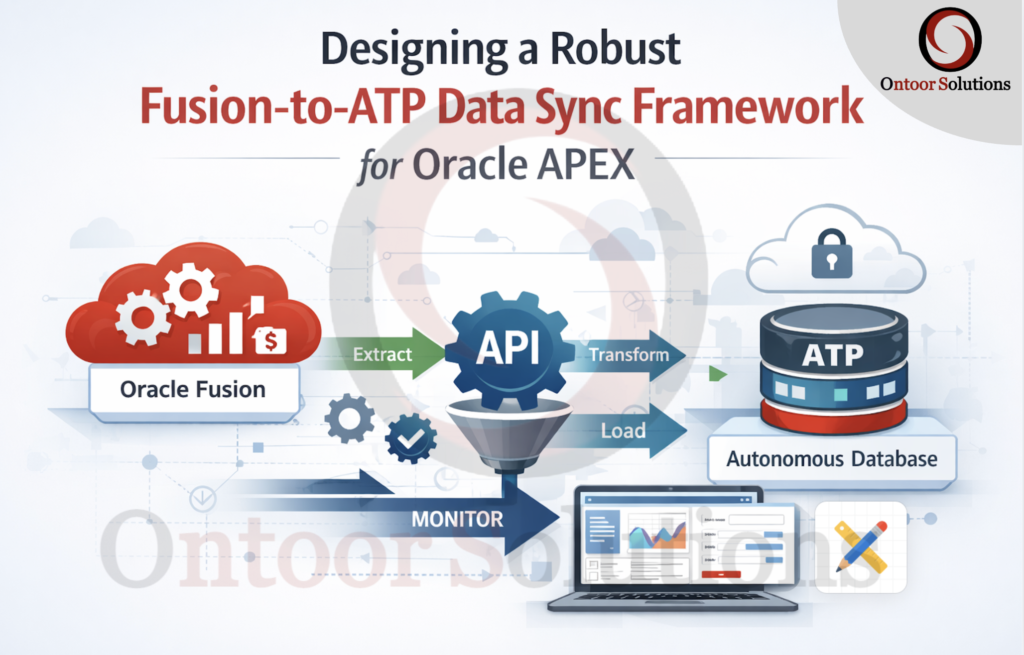
This blog explains a practical, real-world architecture to copy data from Oracle Fusion into Oracle Autonomous Transaction Processing (ATP) and then use that data in Oracle APEX. With this approach, Fusion continues to handle transactions, while ATP and APEX handle reporting and custom logic—without affecting Fusion performance
Architecture Overview
The data flow follows a multi-stage approach to ensure reliability and performance:
Extract: Fusion BI Publisher generates incremental CSV files.
Transport: Files are pushed to an SFTP server and then moved to OCI Object Storage via Oracle Integration Cloud (OIC).
Ingest: A PL/SQL procedure in the ATP database uses DBMS_CLOUD to pull data into a staging table.
Merge: Data is synchronized from the staging table to the final target table.
Step 1: Create the Data Model
The first step is to define the data source and the query that will extract the incremental data.
Navigate to the Catalog in Oracle Fusion BI Publisher.
Click on Create and select Data Model.
In the Data Model editor, click on New Data Set and select SQL Query.
Give your data set a name (e.g., Source_Data), select the appropriate Data Source (e.g., ApplicationDB_FSCM), and enter your SQL query.
The query should include a WHERE clause to filter for data modified within a specific timeframe to ensure incremental extraction.
Step 2: Create the Report Layout
Once the data model is saved, you need to create a report that uses this data model and specifies the output format.
From the data model, click on Create Report.
Follow the wizard to create a basic report layout. Since the output will be a CSV file for machine processing, a simple, generic layout is sufficient.
In the report editor, click on View a List to see the available output formats.
Ensure that CSV is selected as an output format. It’s a good practice to set it as the Default Format.
Step 3: Schedule the Report
The next crucial step is to schedule the report to run at a high frequency and deliver the output to an SFTP server.
Locate your saved report in the catalog and click on Schedule.
In the Schedule tab, define the frequency. For near real-time synchronization, a frequency of every 5 to 10 minutes is recommended.
In the Output tab, configure the destination. Select FTP as the Destination Type.
Choose your registered FTP Server, specify the Remote Directory, and provide a Remote File Name. Use a dynamic filename (e.g., with a timestamp) to prevent overwriting and to create an audit trail.
Step 4: Monitor the Job History
After scheduling the report, it’s important to monitor its execution to ensure data is being extracted and delivered successfully.
Navigate to the Report Job History page in BI Publisher.
Search for your scheduled report job.
Verify that the job’s Status is Success for each execution. You can also check the start and end times to confirm the schedule frequency.
Next Steps:
After successfully configuring the BI Publisher report to deliver incremental CSV files to the SFTP server, the subsequent steps in the data synchronization pipeline are:
Oracle Integration Cloud (OIC): Create an integration that periodically polls the SFTP server, picks up the new CSV files, and uploads them to an OCI Object Storage bucket.
Autonomous Transaction Processing (ATP): Develop a PL/SQL procedure that uses DBMS_CLOUD.COPY_DATA to load the data from the Object Storage bucket into a staging table.
Data Merge: Implement a MERGE statement within the PL/SQL procedure to synchronize the data from the staging table to the final target table, handling both inserts and updates.
High-Level Architecture
Integration Layer – Moving Files Out of Fusion
Role of the Integration Layer
The integration layer acts as a neutral courier between Oracle Fusion Applications and downstream platforms.
Its responsibility is limited to file movement, reliability, and isolation—not data transformation or business logic.
In this architecture, the integration layer performs the following functions:
Periodically polls the Fusion SFTP location
Identifies and picks up eligible incremental CSV files
Transfers files to OCI Object Storage
Handles retries, failures, and transient connectivity issues
Operates independently of the ATP database
By running asynchronously, the integration layer ensures that neither Fusion nor ATP is impacted by temporary outages or processing delays.
Why This Layer Is Critical
A direct Fusion → ATP connection introduces tight coupling between a transactional system and a reporting database. Such designs are fragile and difficult to recover from failures.
Introducing an integration layer:
Isolates Fusion from downstream processing issues
Prevents ATP availability from affecting Fusion schedules
Enables controlled, retryable, and auditable file movement
This separation is essential for building a resilient and supportable enterprise integration.
Step 5: Object Storage as a Decoupling Layer
OCI Object Storage serves as the central buffering and decoupling layer in the pipeline.
It is not just a storage destination—it is a fault-tolerance mechanism.
Example Bucket:
fusion-data-dropzone
Why Object Storage Is Mandatory
Each extracted CSV file is stored as an immutable object, creating a durable checkpoint between systems.
Using Object Storage provides several architectural guarantees:
Buffers data between the producer (Fusion) and the consumer (ATP)
Enables replay and recovery without re-extracting data
Prevents partial or inconsistent database loads
Fully decouples Fusion availability from ATP processing
Object Storage makes the pipeline fault-tolerant.
Step 6: Sample Object Storage URL (For Understanding)
https://objectstorage.ap-mumbai-1.oraclecloud.com
/n/demo_namespace/b/fusion-data-dropzone/o/daily_extracts/supplier_profile_20260121.csv
This example illustrates:
Logical folder organization
Time-based file naming
How ATP later references the file for ingestion
Step 7: Creating Database Credential in ATP
ATP accesses Object Storage using DBMS_CLOUD credentials.
BEGIN
DBMS_CLOUD.CREATE_CREDENTIAL(
credential_name => ‘OBJ_STORE_CRED’,
username => ‘oci_user@example.com’,
password => ‘OCI_AUTH_TOKEN’
);
END;
/
Secure Access from ATP to Object Storage
Autonomous Transaction Processing (ATP) accesses Object Storage using DBMS_CLOUD credentials.
These credentials are stored securely inside the database and referenced by name during data load operations.
Architectural Characteristics
Uses OCI Auth Tokens, not OCI user passwords
Created once and centrally managed
Reused across multiple load jobs
Keeps credentials out of PL/SQL code and application logic
This approach follows Oracle security best practices and ensures that database code remains clean, secure, and portable.
Architectural Outcome
At this stage of the pipeline:
Fusion remains isolated from downstream systems
File movement is asynchronous and retry-safe
Data ingestion is secure and credential-managed
The foundation is ready for staging and merge operations in ATP
This prepares the architecture for the next phase—loading data into ATP staging tables and synchronizing it into final business tables.
Step 8: Listing Files from Object Storage
Before any data is loaded into ATP, the framework performs a pre-load discovery step to identify which files are available for processing in OCI Object Storage.
SELECT object_name,
bytes,
last_modified
FROM DBMS_CLOUD.LIST_OBJECTS(
credential_name => ‘OBJ_STORE_CRED’,
location_uri =>
‘https://objectstorage.ap-mumbai-1.oraclecloud.com/n/demo_namespace/b/fusion-data-dropzone/o/daily_extracts/’
);
Rather than assuming the presence of files, the system explicitly queries the Object Storage bucket to retrieve metadata such as:
File names
File sizes
Last modified timestamps
This discovery step ensures that the data load process is intentional, traceable, and controlled.
Why This Step Is Important
Listing objects from Object Storage enables several critical architectural capabilities:
Validation
Confirms that expected extract files are present before attempting a load.
Logging and Auditing
Captures which files were detected, processed, or skipped during each run.
Operational Debugging
Helps quickly diagnose missing, delayed, or duplicate files without rechecking Fusion or SFTP.
Idempotent Processing
Supports safe re-runs by allowing the framework to decide which files should be processed again.
Step 9: Raw Landing (Staging) Table Design
Example Table
CREATE TABLE supplier_raw_load (
supplier_id VARCHAR2(2000),
supplier_name VARCHAR2(2000),
supplier_status VARCHAR2(2000),
last_update_date VARCHAR2(2000)
);
The raw landing table is the initial ingestion layer for files loaded from Object Storage.
Its only responsibility is to accept data without rejection.
Design Characteristics
Column order must exactly match the CSV structure
All columns defined as VARCHAR2
No primary keys or constraints
No indexes
No validation logic
Rationale
File ingestion must be deterministic and failure-free.
Data validation and transformation are deferred to downstream processing steps.
Step 10: Copying Data from Object Storage into ATP
Data is loaded into the raw landing table using DBMS_CLOUD.COPY_DATA, which is the supported bulk-load mechanism for ingesting files from OCI Object Storage into Autonomous Transaction Processing (ATP).
BEGIN
DBMS_CLOUD.COPY_DATA(
table_name => ‘SUPPLIER_RAW_LOAD’,
credential_name => ‘OBJ_STORE_CRED’,
file_uri_list =>
‘https://objectstorage.ap-mumbai-1.oraclecloud.com/n/demo_namespace/b/fusion-data-dropzone/o/daily_extracts/supplier_profile_20260121.csv’,
format => JSON_OBJECT(
‘type’ VALUE ‘csv’,
‘skipheaders’ VALUE ‘1’,
‘delimiter’ VALUE ‘,’,
‘trimspaces’ VALUE ‘true’
)
);
END;
/
The procedure reads the CSV file directly from Object Storage and inserts the data into the raw staging table in a single operation.
Why DBMS_CLOUD.COPY_DATA
Optimized for bulk data loading
Designed for large file ingestion
Avoids row-by-row processing
Provides predictable and repeatable load behavior
Architectural Outcome
Fast and reliable ingestion into ATP
No dependency on application-level insert logic
Clean separation between file ingestion and data processing
Step 11: Business Target Table Design
CREATE TABLE supplier_profile_master (
supplier_id VARCHAR2(100) PRIMARY KEY,
supplier_name VARCHAR2(500),
supplier_status VARCHAR2(50),
last_update_date DATE,
active_flag CHAR(1)
);
The business target table stores cleaned and typed data optimized for Oracle APEX reporting and query performance.
It represents the consumable layer, not a transactional system of record.
Design Characteristics
Proper data types applied (DATE, bounded VARCHAR2)
Primary key defined for uniqueness
Minimal constraints, focused on read efficiency
Structured for reporting and analytics use cases
Step 12: Merge (Upsert) Logic
Data from the raw landing table is synchronized into the business table using a MERGE-based upsert pattern.
MERGE INTO supplier_profile_master tgt
USING (
SELECT supplier_id,
supplier_name,
supplier_status,
TO_DATE(last_update_date,’YYYY-MM-DD’) last_update_date
FROM supplier_raw_load
) src
ON (tgt.supplier_id = src.supplier_id)
WHEN MATCHED THEN
UPDATE SET
tgt.supplier_name = src.supplier_name,
tgt.supplier_status = src.supplier_status,
tgt.last_update_date = src.last_update_date,
tgt.active_flag = ‘Y’
WHEN NOT MATCHED THEN
INSERT (
supplier_id,
supplier_name,
supplier_status,
last_update_date,
active_flag
)
VALUES (
src.supplier_id,
src.supplier_name,
src.supplier_status,
src.last_update_date,
‘Y’
);
Why MERGE Is Used
Idempotent processing
Safe for repeated executions
Prevents duplicate records
Supports incremental synchronization
Architectural Outcome
Consistent target state after every run
Controlled handling of inserts and updates
Reliable recovery and reprocessing
The target table always converges to the correct state, regardless of how many times the job runs
Step 13: Handling Deleted / Missing Records
After a file has been successfully loaded into the raw landing table and merged into the business target table, it must be removed from OCI Object Storage.
Why Files Are Deleted Post-Merge
Prevents duplicate processing
Clearly marks files as completed
Controls storage growth
Simplifies operational monitoring
File deletion acts as a processing acknowledgment, not a data deletion signal
BEGIN
DBMS_CLOUD.DELETE_OBJECT(
credential_name => ‘OBJ_STORE_CRED’,
object_uri => ‘https://objectstorage.ap-mumbai-1.oraclecloud.com
/n/demo_namespace/b/fusion-data-dropzone/o/daily_extracts/supplier_profile_20260121.csv’,
force => FALSE
);
END;
/
Parameter Explanation
credential_name
DBMS_CLOUD credential created using OCI Auth Token
object_uri
Full Object Storage URI of the processed file
force = FALSE
Ensures controlled deletion (recommended)
Step 14: Logging & Audit Framework
A dedicated logging table tracks the lifecycle of every file processed by the pipeline.
This table provides operational visibility, not business reporting.
Example Log Table
The log captures:
File identity and source
Processing start and end times
Final execution status
Error details, if any
Logging Strategy
One log entry per file per execution
Status recorded as SUCCESS or FAILURE
Errors captured at the exact failure point
Logs written before and after each major stage
CREATE TABLE data_sync_log (
object_name VARCHAR2(100),
file_name VARCHAR2(500),
start_time DATE,
end_time DATE,
status VARCHAR2(20),
error_message VARCHAR2(4000)
);
INSERT INTO data_sync_log
VALUES (
‘SUPPLIER_PROFILE’,
‘supplier_profile_20260121.csv’,
SYSDATE,
NULL,
‘STARTED’,
NULL
);
Step 15: Exception Handling Pattern
Each data object is processed independently within its own execution scope.
Failures are captured and logged, not propagated to stop the entire pipeline.
Handling Strategy
Wrap load and merge logic in a controlled exception block
Update audit logs with SUCCESS or FAILED status
Capture error details at the failure point
Always record end time, regardless of outcome
BEGIN
— load & merge
UPDATE data_sync_log
SET status=’SUCCESS’, end_time=SYSDATE
WHERE object_name=’SUPPLIER_PROFILE’;
EXCEPTION
WHEN OTHERS THEN
UPDATE data_sync_log
SET status=’FAILED’,
error_message=SQLERRM,
end_time=SYSDATE
WHERE object_name=’SUPPLIER_PROFILE’;
END;
/
Step 16: Cleanup & Repeatability
After successful processing of a data object:
Raw landing tables may be truncated
Processed files are either deleted or archived
Execution moves to the next object
This ensures predictable and repeatable execution for every run.
Step 17: Oracle APEX Characteristics
Oracle APEX consumes data only from business target tables.
Reads only curated business tables
Never accesses raw staging tables
Never reads files from Object Storage
Never calls Fusion APIs at runtime
Result
Fast reports
Stable dashboards
Zero runtime integration risk
Why This Architecture Works
Incremental — processes only changed data
Decoupled — no runtime dependency between Fusion, ATP, and APEX
Replayable — files can be safely reprocessed from Object Storage
Auditable — every file and run is logged and traceable
Secure — no direct Fusion access; credentials are centrally managed
Scalable — supports growing data volumes and additional objects
APEX-friendly — optimized for fast, stable reporting
The post Designing a Robust Fusion-to-ATP Data Sync Framework for Oracle APEX appeared first on Ontoor blogs.